
Gaiman, Neil, and Dave McKean. 2008. The Graveyard
Book. New York:
HarperCollins Pub. ISBN 9780060530945
Summary
A murderer named Jack enters a home to kill all the
occupants, but the toddler has crawled out of his crib and Jack cannot find him
to finish the murderous work. The toddler makes his way to the cemetery where his
deceased mom as a ghost exacts a promise from the Owens that they will
take care of him. He is raised in the graveyard by the ghosts, the ghouls, and
the witch and is given the Freedom of the Graveyard which allows him to do what only the dead can do. Because he looks like nobody, he is given the name "Bod."
After years of wonderful graveyard living ventures out to experience the ghastly land of the living.
Critical Analysis
Bod and his fellow characters of ghosts, ghouls, the witch
and other humans provide unexpected relationships in The Graveyard Book as readers understand Bod’s situation better
than he does. This dramatic irony occurs because we are there when his family is
killed, and so we understand that he is an orphan in the cemetery while he does
not. He does not even understand what an orphan is or how unusual his life is. Readers will like Silas, Bod's guardian from the cemetery, even though he is a bit of as mystery. Bod is told, “You aren't allowed out of the graveyard […] because it’s only in the graveyard that we can keep you safe. This is where you live and where those who love you can be found. Outside would not be safe for you. Not yet.” Gaiman grabs the reader's attention with Bod's experiences with supernatural events.
Because bod must be hidden from the killer, he has little interaction with living people and it is not until he is older that he goes to school outside the cemetery. Then we feel his pain for the rough treatment from living people. When Bod goes out of the graveyard, the obstacles and occurrences are very logical to the story. It is rather ironic that the witch, werewolf, and such are the good characters while the living human enemies such as the school bully are the evil ones. Gaiman writes in such a way that it feels very believable.
Because bod must be hidden from the killer, he has little interaction with living people and it is not until he is older that he goes to school outside the cemetery. Then we feel his pain for the rough treatment from living people. When Bod goes out of the graveyard, the obstacles and occurrences are very logical to the story. It is rather ironic that the witch, werewolf, and such are the good characters while the living human enemies such as the school bully are the evil ones. Gaiman writes in such a way that it feels very believable.
The setting takes the reader into the
cemetery. Bod has Graveyard powers and we picture the graveyard as he
experiences these powers – and as he loses them when he is leaving the
graveyard. “Bod leaned down to push his head into the grave and call his
friend, but instead of his head slipping through the solid matter like a shadow
passing through a deeper shadow, his head met the ground with a hard and
painful thump.” At times, the story seems like it is from long ago, but that
cannot be since the bully has a video at school. The story line, however, could be for any time in history.
Death is with humans through all times, and this story
brings the living and the dead together. In fact, the contemporary saying of
“it takes a village to raise a child” is taken to the cemetery where it “takes
a cemetery" to raise the child. Bod experiences the coming of age theme while being torn between those
he loves who have raised him and a desire to go out and see the
world. The book has the reader cheering for good to triumph over evil.
The narration is in third person and we not only get to know
Bod’s thoughts, but the other characters’ thoughts as well. The dialogues are cleverly written with
consistent and distinct voices for the characters. The ending of the book,
though satisfying, leave us begging Gaiman to write a sequel.
Review Excerpts
Booklist, starred - "This is an utterly captivating tale that is
cleverly told through an entertaining cast of ghostly characters. There is
plenty of darkness, but the novel's ultimate message is strong and life
affirming."
Library Journal - "An elegant
combination of Gaiman's masterly storytelling and McKean's lovely drawings,
this book also works as a series of independent but connected short stories set
two years apart, following Bod from age two to 16."
VOYA
- "Everyone who reads this book will hope fervently
that the very busy author gets around to writing one soon."
Connections
View and listen to the author, Gaiman, read from the book and answer questions.
http://www.mousecircus.com/videotour.asp
See illustrations gallery by Chris Riddell. http://www.thegraveyardbook.co.uk/ and draw renditions of various passages or characteristics.
Make a map of the graveyard.
View the cemetary Gaiman uses a basis for his imaginary one in the book. http://www.youtube.com/watch?v=_-Y9IlFYJRU
Write why others should read this book.
Make a book trailer.
Readers Theatre.
Listen to the audiobook. ISBN 9780747599760
Watch The Graveyard Book movie development online directed by Ron Howard.
Watch film, Beowulf, written by Gaiman.
Read Gaiman’s graphic novel, Sandman.
Read Gaiman’s short story, M is for Magic.
Play Graveyard Book online games. http://www.mousecircus.com/bookdetails.aspx?BookID=1
Awards
Newbery Medal award winner 2009
ALA Best Books for Young Adults 2009
ALA Notable Children's Book
Andrew Carnegie Medal 2010
Time Magazine Top Ten Fiction
Hugo Award
Awards
Newbery Medal award winner 2009
ALA Best Books for Young Adults 2009
ALA Notable Children's Book
Andrew Carnegie Medal 2010
Time Magazine Top Ten Fiction
Hugo Award
The Book Thief
Bibliography
Zusak, Markus. 2006. The book thief. New York: Alfred A. Knopf. ISBN 9780375831003
Summary
How fitting that Death narrates the
story of a schoolgirl who lives in a foster home in Nazi Germany after losing
her brother and mother. Her new foster father, Hans, teaches Liesel to read, and she begins with the first book she stole at her brother's grave, The
Gravedigger's Handbook. Liesel's relationships with the hidden
Jewish man in the basement, with her friend who idolized Jesse Owens, and with
others show a different side of German citizenship during World War II. This book
is especially good for grade 7 readers through adulthood.
Critical Analysis
The Book
Thief provides strong characters, an engaging plot, and a theme to be remembered. Readers find themselves growing with Liesel
as she journeys through the sorrow of the death of her brother, the loss of her
mother, and the engaging experience of living in a foster home. We see her
determination to read and her drive to steal books. Her relationship with
neighborhood friend, Rudy Steiner, is one which will interest the youthful
reader. Rudy continually asks Liesel for a kiss, but alas, only receives it
when she finds him dead on the street after a bombing. Other characters are
also well developed. Hans, her foster father, has a very close and loving
relationship with Liesel teaching her to read and sitting with her after her
nightmares. He has to deal with joining the Nazi army, but also hiding his
World War I Jewish friend’s son, Max. They hide Max in the basement, and his
connection with Liesel is a moving part of the story. We see the tough side of
Liesel’s foster mother, Rosa, but we also see that she greatly
cares for her family including he foster daughter. Liesel deals with
all of this in a realistic way for a girl her age and readers go through her
pains and her joys.
The plot is
all too true to life – and death – during the time period of World War II. In
the last line of the book Death states, “I am haunted by humans.” We see the World War II experiences of cruelty, but also the
kindness of others. Foreshadowing is used
throughout the story such as when Death refers to Liesel as the “perpetual survivor.” We know a bit about what will happen to Rudy before the sad events are detailed.
Readers learn about living in Germany during World War II. The government searched for fitting bomb shelters. After the bombing the narrator states, "She did not know where she was running, for Himmel Street no longer existed. . . Why was the sky red? How could it be snowing? And why did the snowflakes burn her arms?”
Liesel’s identity
and her relationships as she grows through her experiences are the major thrust behind the story. She realizes the
power of words as she begins to discern Hitler’s propaganda and the importance
of books. The mayor’s wife allows Liesel to read (and steal) books from her
home library and then gives Liesel a blank book in which to write. Liesel’s
ending line in her personally written book is, “I have hated the words and I have loved them, and I hope I
have made them right.” We consider humanity and the treatment of a people group as we get to know Max while he is in hiding and then marched
off to prison camp.
In a most
unusual voice, we hear the story from the narrator, Death. “I
watched. Twenty-three minutes later, when the train was stopped, I climbed out
with them. A small soul was in my arms. I stood a little to the right. The
dynamic train guard duo made their way back to the mother, the girl, and the small
male corpse.” In an unusual view, we see Death’s compassion and
tenderness with Liesel becoming a heroine with her own braveness. The dialogue
among the characters is natural and believable, at times inserting German words
and phrases such as the name calling.
This is a book which will especially
interest junior high and high school students, boys and girls alike. They will
like the freshness of Death as a narrator. They may listen to an audio book or
read it, but either way, they will long remember it.
Review Excerpts
Booklist - "There's too much commentary at the outset,
and too much switching from past to present time, but as in Zusak's
enthralling I Am the Messenger (2004), the astonishing characters,
drawn without sentimentality, will grab readers. More than the overt message
about the power of words, it's Liesl's confrontation with horrifying cruelty
and her discovery of kindness in unexpected places that tell the heartbreaking
truth."
Horn Book, starred – “Exquisitely written
and memorably populated, Zusak's poignant tribute to words, survival, and their
curiously inevitable entwinement is a tour de force to be not just read but
inhabited.”
Kirkus Reviews, Starred - "Elegant, philosophical and
moving...Beautiful and important."
New
York Times - "Brilliant and hugely ambitious…Some will argue
that a book so difficult and sad may not be appropriate for teenage
readers…Adults will probably like it (this one did), but it’s a great
young-adult novel…"
School Library Journal,
Starred - "An extraordinary narrative.”
Connections
Study World War II.
Study German Youth Resistance Groups
and/or German Youth.
Read Hitler Youth ISBN
978-0439353793.
Listen to the author speak about his
inspiration for writing The Book Book Thief: http://www.youtube.com/watch?feature=player_embedded&v=m7B8ioiZz7M
Awards:
Printz Honor Book, 2007
ALA
Best Book for Adults, 2007
New York Times Bestseller List
Parents' Choice Gold
Award, 2006
Book Sense Book of
the Year, 2007
Daniel Elliot Peace
Award, 2006
School Library
Journal Best Book of the Year Award, 2006
Outstanding Books for
the College Bound, 2009
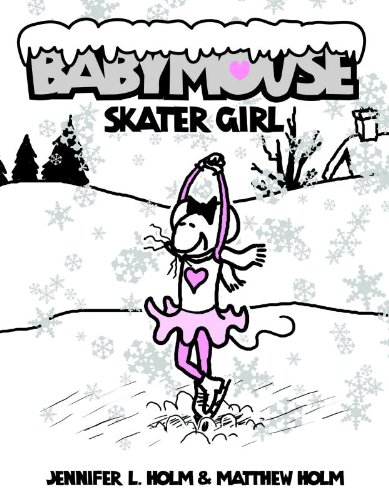
Babymouse. 7, Skater Girl
Bibliography
Holm, Jennifer, and
Matthew Holm. 2007. Babymouse
7 Skater Girl. New York, NY: Random House Childrens Books. ISBN 9780375839894
Summary
In this graphic novel
Babymouse series book, Babymouse
wants to be the best at something and one day she realizes it could be ice
skating. Her training permeates every part of her life
including her sleep, food intake, homework, and friends. The motto of "winning is
everything" rings shallow and she realizes that sometimes you have to quit to be
happy.
Critical Analysis
Even though the
protagonist is a mouse, children will readily identify with the feeling that everyone else has something they are the best, but she has nothing. They will feel a
connection with Babymouse when her classmates make fun of her for not having any trophy.
Readers will see this common U.S. plot as real, even though
the characters are speaking animals. When a well-known coach sees Babymouse skating and
becomes her trainer, Babymouse feels joy followed by the pain of having
no time for cupcakes nor friends. She has to decide if winning IS everything.
The setting could be
anyone’s school, anyone’s home, anyone’s town. When Babymouse is skating, she is barged into by ice hockey players, the rough and tough jocks making life tougher for others. She drinks hot chocolate after making a
snowmouse. The details of the story make Babymouse come to life for readers.
Babymouse has to
decide if all the sacrifices she has to make are worth the goal of being the
best. The value of friendship rings out as she chooses friendship and cupcakes
over the title of “The Best.” The ending moral is summarized in this statement,
“Sometimes you have to quit to find out what
makes you happy."
Each character has
his or her own voice through the speaking bubbles which grab the reader’s
attention from the very beginning. The story takes the readers through feeling less than
everyone else, working to become the best, and finally deciding it is not
worth the sacrifice. Even though it is not this writer’s favorite theme to set
before children, the story is masterfully told through word and illustrations
and the readers will love another Babymouse graphic novel by the Holm
siblings.
Booklist – “Once again the
brother-sister creative team hits the mark with humor, sweetness, and
characters so genuine they can pass for real kids. Cute,
smart, sassy Babymouse is fun and funny, and this book,
like its predecessors, will draw reluctant readers as well
as Babymouse fans.”
Horn Book, starred - "You'd
think the Holm siblings would have trouble keeping their own performance fresh,
but for artistic expression, technical difficulty, and presentation they remain
an eminently competitive pair."
The Chicago
Sun-Times:
"Move over, Superman, here comes Babymouse!"
"Move over, Superman, here comes Babymouse!"
Connections
Read other books in
the Babymouse graphic novels.
Readers Theatre.
Dramatize a part of
the story.
Examine values and priorities
and what it takes to be the best.
Create a new scene
for a Babymouse story.
Awards
Children's Choice awards - Babymouse Books.
Awards
Children's Choice awards - Babymouse Books.

No comments:
Post a Comment